
Interview - Craig Morton, Brushmaker
Published on 30.03.2026 by Charlotte
Published on 30.03.2026 by Charlotte
Guest Post: Interview by Apolina – this article appears in their latest newsletter
Our ongoing Craft series explores and champions British crafts, techniques and skills, particularly those that are becoming increasingly ‘endangered’, and at risk of being diluted or overlooked. At Apolina we believe craft deserves space, attention and respect. We hope that by sharing the stories of expert craftspeople, together we will deepen our understanding of how the objects in our lives are made, to encourage more conscious appreciation and consumption.
This month we’re grateful for the opportunity to shine a light on the work of…
Craig Morton of A.S. Handover, a British brushmaking company that specialises in supplies for gilders, signwriters, pinstripers, specialist decorators, artists and a wide range of other craftspeople.
You first got into brush making aged 17, when visiting your mum at the original Edward Mason brush factory where she wired specialist mop brushes. What did your learning journey look like, and how long was it before you felt confident in your skills?
There were no formal training schemes nor qualifications of any kind, but I was fortunate to arrive at a time when there were still some original employees that had started in the 1940s. I spent days and weeks with each person learning different skills from them. I had always been hands-on as a child with hobbies such as model making, woodworking, drawing, etc. – things that required close attention to detail, so I picked up the skills readily.
Confidence came gradually. I would say I felt confident in my skills within two years, across a broad range of materials. Even after 39 years I never consider my training to be complete, there is always something more to learn, and we should always be open to other ideas and methods.
Could you talk us through the process and steps of making a brush from start to finish?
This can vary wildly depending on the type of brush being made, but taking a chisel-edged sign painting brush as an example:
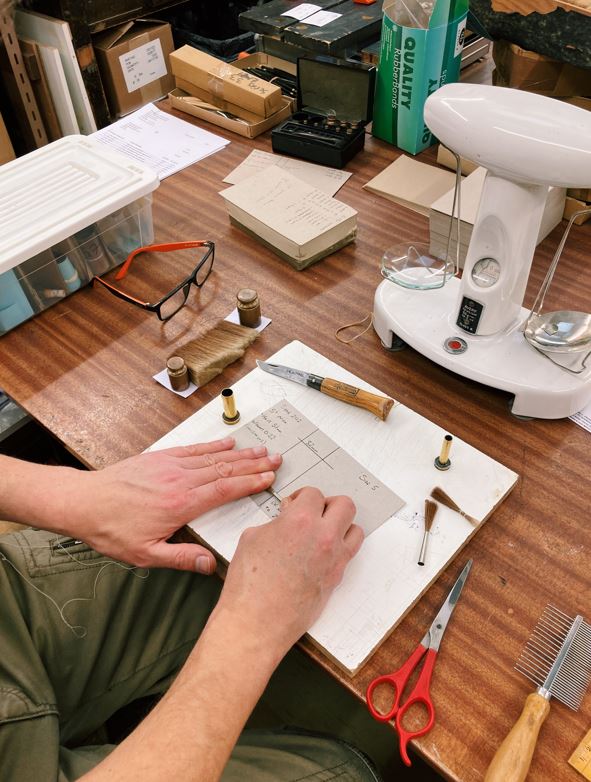
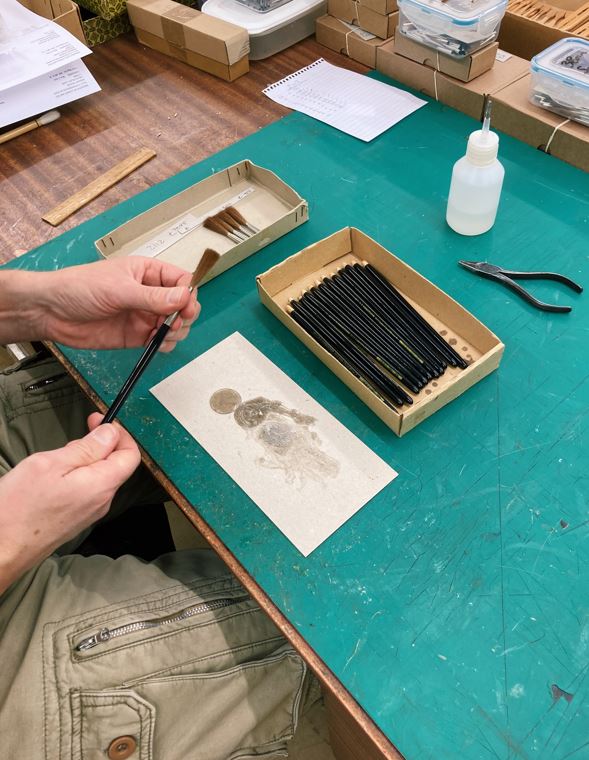
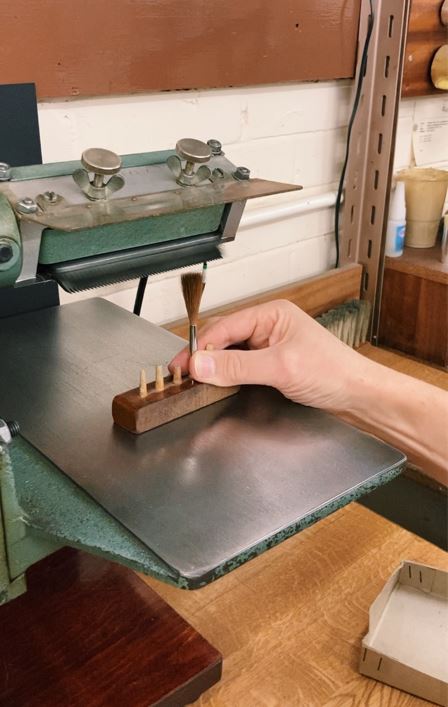
The hair is “dressed” ready for us to use, but we must dress it further, picking out blunt/white/turned hairs with a sharp blade and then combing and “knocking down” the hair in a brass cannon (often old shell casings), until all the tips are level. The hair from here is carefully inserted in the ferrule and checked for fit – more hair may be needed or some taken out until we have the perfect fit. Then it’s knocked down again to give that perfect chisel edge, and pulled out to the right length. Once the batch is made they are then set in a special two-part adhesive and left to dry for two days.
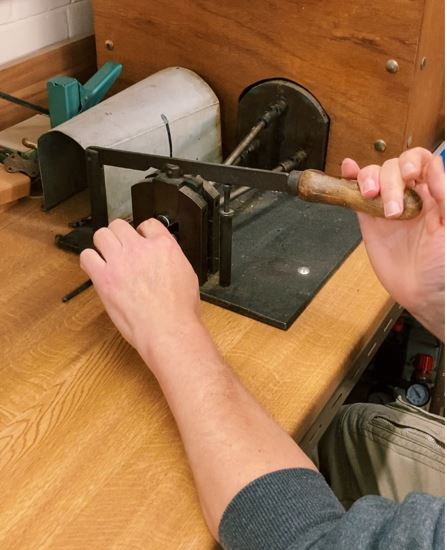
After this the handles must be printed, fitted and crimped on. All the brushes are checked for loose hairs and wet tested to check that the performance is perfect.
Which part of the process took the longest to master, and why?
Handling any hair is the number one hardest skill to master. From there making a domed or pointed mop type brush from scratch and forming the shape entirely by hand. Controlling the length and shape whilst holding all of the hair together in a piece of thread requires high concentration and all the skills acquired over the years!
As a British company we’re interested in where the components you use, such as the wood, hair and ferrules, come from. How much do you create in-house?
Unfortunately there are no British manufacturers of handles or ferrules left. We work closely with our suppliers in Germany for these items. Hair has always come from all around the world and is supplied through our trusted supplier based in North London. We still make many of the very specialist handles in our own workshops by hand.
What do you think separates a truly handmade brush from a mass-produced one?
Nothing can replace the years of skill put into a handmade brush. A machine cannot feel/see when the shape is just right, the tip absolutely needle point perfect.
Your son now makes brushes too, the third generation in your family. How many brush-makers do you have on your team?
Brushmaking is now a red-listed Heritage craft in the U.K. We have a small, dedicated team of five highly-skilled makers here at A.S. Handover, with over 100 years of experience between us.
Thank you to Apolina for your interest in our craft.
To learn more about brushmaking, you can read our blog ‘Edward Mason Ltd and the making of a 2112 series brush’ here >
For more information on the chisel brushes we offer please check out our brush guide or, as always, please feel free to send any questions to us on [email protected]!
Hooray!
Product added to basket!

